Friday, April 5, 2013

Day 4 Berlin - Prague

Our final day in Berlin began with a stop on the Unter den Linden Strasse on the plaza in front of Humboldt University. It was here, on May 10, 1933, that students participated in one of the many book burnings throughout Germany, orchestrated by the Nazi leadership. On that day, right-wing students went into the university libraries and pulled out books written by Jews or by authors ‘under the Jewish influence’, and threw them on a huge pyre on the plaza. Books by authors Sigmund Freud or Heinrich Mann were burned, but books about non-Jews were also destroyed, such as ones with the art of Pablo Picasso. Though Picasso was not Jewish, the Nazis reasoned that anyone who would create such paintings as “Woman with book" 1932 or rather than creating such masterpieces as 19th century German Romantic landscape painter Caspar David Friedrich must have had their creativity ‘bastardized’ by a Jewish influence. The Nazis called this art ‘degenerate art’.  Mr. Barmore told us of a man named Heinrich Heine, one of the most significant German poets of the 19th century. His radical political views of the time led to his works being banned by German authorities. One hundred years before the Nazis came to power Heine, in 1820, had prophesised “where they burn books, one day they will burn people.”


He also told us that it was, perhaps, even fortuitous that there had been this rejection of "Jewish ideas" in 1933 which essentially stopped the work of nuclear physicists in the 1930’s in Germany, causing many of them to emigrate to the United States. If this had not occurred, it might have been that Germany would have developed the atomic bomb before the United States.
Michael Ullmann constructed a memorial, “Empty Library”, on the plaza to commemorate the site of the book burnings. If you did not know about it you might walk right past it, even walking over it. There is a clear glass panel (about four feet square] embedded into the plaza floor. Looking down through the panel, one sees empty library shelves and in front of them, is glass, so that as you look at the empty shelves you see the image of yourself. In this way, you, as the observer, are unable to distance yourself from this event. “It puts you into the memory”, said Mr. Barmore. Unfortunately, inasmuch as the glass panel was frozen, we were unable to view the bookshelves and could only use our imagination to picture the memorial.
Our last stop in Berlin would be to the Jewish Museum Berlin. On Wednesday we had visited the German Historical Museum which had given us an overview of German history. The Jewish Museum Berlin, designed by architect Daniel Libeskind, which opened in 2001, focuses on two thousand years of German-Jewish history.

Entering the Museum’s basement brought us to three axes. Two of them – the “Axis of Exile” and the “ Axis of the Holocaust” focus on the Nazi era. The third axis, the “Axis of Continuity” leads up several flights of stairs to the permanent exhibition which takes visitors through two floors of German Jewish history, beginning with the first Jewish communities in the Middle Ages, through Moses Mendelssohn’s contributions to the Enlightenment, the process of assimilation of Jewish citizens, the Holocaust and rebuilding of the Jewish community in Germany after 1945 to the present day.


Olaf began our tour with the Axis of the Holocaust. In this section we could see personal documents and objects that told of Nazi persecution. The museum is rich in symbolism, with many empty spaces, so-called ‘voids’ that rise vertically from the basement to the roof inside the building. Mr. Libeskind has said of these ‘voids’, that he could not deny the Holocaust in his design of the building, but needed to make it visible and part of the museum. One such void we were taken to by Olaf was the “Holocaust Tower”, an empty 24 meter high spaced, unheated, lit by natural light falling through a diagonal opening in the wall. Sounds are audible from outside the building. This space has been interpreted as a commemorative space for victims of the Holocaust, but visitors are invited to make their own, personal interpretation of the spaces. Olaf said it reminded him of being “in the world, and yet disconnected from it” as Mr. Barmore had often referred to the German Jews and their situation.
 
In another section called "Memory Void" , one exhibit has 10,000 faces punched of steel.  Entitled "Fallen Leaves", Israeli artist Menashe Kadishman dedicated his artwork to the memory of the Jews killed in the Holocaust as well as to all victims of violence.  Visitors are invited to enter the void and walk on the faces, listening to the sounds that are created by the faces clanging against one another.  
In the Garden of Exile stand 49 titled columns on sloping ground. Olaf told us that exile meant rescue and safety but arrival in a foreign country also caused feelings of disorientation. Refugees often had difficulty gaining a solid foothold in their new home, hence the uncertain path visitors must walk as they wander through the columns.
Mr. Barmore would then take us through the permanent exhibition, after giving us a brief background of Jews in Germany. By the year 1000 Europe is Christianized; Christianity representing a cementing ideology between groups of people. The relationship between the Christian and Jewish communities in Europe in the second millennium will deteriorate. The relationship was seemingly better in the first millennium than the second millennium perhaps because of the Crusades. As a result, Jews were now the object of very ambivalent attitudes – at best they were tolerated. According to Christian doctrine, Jews had killed Christ, and yet on the other hand Jews had been given certain privileges by the king. They had been invited by the king, were property of the king and as such, were protected by him. Jews were able to pay taxes and were therefore a source of revenue for the ruler so they were protected.
One of the other important and enduring features of Jewish civilization is that Jews were literate and had always been literate. From the age of 3, Jewish boys began to learn to read so that they could study the Torah. Every Jewish male was literate and many Jewish women. In contrast, the average European citizen began to be literate from the beginning of the 20th century when education began to be mandated. This gave Jews certain obvious advantages, but in the eyes of Europeans this was unsettling in that this ability appeared to give them special powers.
 

At this time Jews were living inside Christian society but were not part of it; the two groups didn’t mix. There were strict rules regarding contact between the groups. For the Europeans, Jews were there to help the nobility. For the Jews, their belief was that they had a special relationship with God; God was keeping them in exile and when God felt they had suffered enough, they would be allowed to return to their homeland. Physical violence and discrimination, therefore, were seen by Jews as more the work of God than the human perpetrators. Wherever they were in exile, though, they knew they needed to make a living and so they had contact with the outside world through their activities in commerce; but for the inside world, they focused on the study of the Torah. This would go on until modern times.


Before two marble statues, one beautiful and sighted; one blindfolded. Mr. Barmore said these were images which would traditionally be found outside churches in medieval times, such as Notre Dame in Paris. The statue on the left represented the church and the statue on the right represented the synagogue, which was unable to see the truth. He said that no one can understand the Holocaust without understanding the roots of Christian antisemitism. Nazi ideology cannot be disconnected from Christian antisemitism , and yet Christian antisemitism would never have committed genocide on the Jews. In Catholicism, the Witness Theory is the belief that Christians will bear witness to the suffering of the Jewish community at the hands of God, for its failure to recognize and acknowledge Jesus as His son. When Jews have accepted the Messiah, all humanity will witness the second coming.

When Jews were emancipated, the wanted to prove they deserved to be equal. When confronted by “You don’t speak our language”, they proceeded to learn the language; when challenged by “You are not part of our culture”, they made it their culture. Jews were emancipated into that society and culture which they grew to love. The problem, Mr. Barmore reminded us, was that it turned out to be an unrequited love; a one-sided love affair. Jews could become too successful in German society, too fast. Jews changed during this process. For instance, he asked us to remember the Old Neue Synagogue in Berlin when it was built. It looked like a church, even an attempt to outdo the other churches in Berlin, and was so very visible to all in Berlin, so that in trying to emulate the German way of living, perhaps some viewed it differently.
Mr. Barmore spoke to us about personal histories which illustrated this concept. A Jewish woman named Rachel Levy married a German noble and became Rachel Varnhagen von Ense. She gave parties in her home and everyone came. She converted to Christianity. She felt she had arrived in society. And yet, he said, she was never invited to any parties. Her husband was invited and instructed not to bring her. The one-sided love affair.

Other Jews were different. When there was an increase in antisemitism, Zionism began and these Jews did not want to assimilate but to emigrate to Erez Israel, or Palestine. It was a chain reaction of events: Jews would react to some action or event, the outside would respond to the Jewish reaction, to which the Jewish community would respond. This, Mr. Barmore said, was why Jews have so many identities. For the Nazis, they concluded that what united these different Jews, was race.
Mr. Barmore spoke to us of the importance of Moses Mendelssohn (1750-1800) who personified many of these changes. He was an orthodox Jew who brought the Enlightenment to Jews also. He felt that if Jews wanted to be emancipated, they needed to reform. As they did that, however, it changed their identity. Most Jews changed, but many didn’t. All of his grand-children converted to Christianity. The question remained: Could one be an enlightened Jew? Could a person be a part of German society but still Jewish? Or did they have to become a Christian German? Could these two be reconciled? The different degrees created different kinds of Jewish identities.

Europe became more anti-Semitic at the end of the 19th century even though it became less Christian. “Why was that?” we were asked. Jews wanted to disappear into German society but as they were assimilating they became more visible. How was that possible? They changed names; they converted. Mr. Barmore challenged us to find an explanation.
As we continued through the history of Jews in Germany, we came to the 20th century – commerce, art and film. Mr. Barmore told us that before the 20th century their religion precluded Jews from drawing human figures, so there were few Jewish artists, but there were many Jews who were art critics, or involved in film or theatre. Hitler even noted, he said, that Jews weren’t artists because they lacked creativity, but they used art, and vulgarized art in film and theatre. Jews were prevalent in film which was seen as vulgarized art and Jews were prominent in journalism which Nazis claimed was the vulgarization of literature. These arguments played into the Nazi ideology that Jews were a destructive element in society, incapable of creativity, but who had a predilection for destroying that which was good in a nation.
The last stop we made in the museum was before a picture of Walter Rathenau, who, Mr. Barmore said, was the symbol of the one-sided love affair he had spoken to us about. Walter Rathenau was the son of Emil Rathenau, a highly successful German Jewish businessman who had established AEG Incorporated. His son, Walter, was nominated, following the loss in World War I, as Foreign Minister for the Weimar Republic and would be sent to Paris to help negotiate what would become the Treaty of Versailles. Two cousins, Albert Einstein and Max Lieberman approached him and begged him to not accept the nomination, fearing that if anything went wrong, the Jews would be blamed, Rathenau’s response was that “I am first a German; and if my nomination helps Germany, I will accept.” Rathenau went to Paris and he signed the Treaty of Versailles which was rejected by consensus of German public opinion. A short while later, he would be shot and killed by a right wing radical. At the trial, Rathenau’s mother spoke to the mother of the son, and is reputed to have said, “If your son knew what a good German he killed, he would have turned his gun on himself.”
We left the museum and drove to the new train station where we said goodbye to our Berlin guide, Olaf, and boarded our train for Prague. The rest of the day was traveling on a five hour train ride through the beautiful countryside, arriving in Prague at 7:30 p.m. where we were met by our Prague guide, Kamila who took us to our hotel and then to dinner at the Municipal House.


Thursday, April 4, 2013

Day 3 Berlin


After another sumptuous buffet breakfast, we boarded our bus for visits to three very different memorials: the Bavarian Quarter memorial, the Grunewald train station memorial, and the Wannsee House. Before heading off, we had our second brief German language lesson from our local guide, Olaf, teaching us some useful phrases.

In a section of western Berlin called the Bavarian Quarter, so named because many of the streets were named after towns and princes in the German state of Bavaria, we were shown an unusual modern memorial. In this middle class section of the city, once lived an estimated 16,000 assimilated German Jews. 

Approximately 70-80% of this section was destroyed during the war, so it is now largely comprised of modern apartment buildings and stores. In the 1980’s the city council decided to put up a memorial in this area. It is comprised of over 80 signs, about 10” x 14” attached to poles throughout the quarter. On one side of each sign is a city ordinance or law which had been enacted against the Jews during the period of 1933 to 1943, and on the other side is a picture or symbol which depicts the essence of that ordinance. These memorial signs are scattered, and we encountered several on our walk around the quarter, noting that they were not in any particular order and not chronological.


Mr. Barmore told us of a saying: “The Holocaust did not come with a bang; it came with a whimper.” If the Final Solution had been attempted in 1933, he said, German society would have objected. But it didn’t happen overnight; it happened slowly. These laws were part of the process of Nazification of German society, happening slowly and over a long period of time, long before the annihilation of European Jews. 

The question was asked, “Did these laws come from above or below?” Who came up with the concept that it was important to make a law which said ‘Jews can’t own pets’, or ‘Jews cannot sing in the city choir’ or ‘Jews can only sit on benches in the public square which are marked specifically for them’? These were not the Nuremberg Laws, but local ordinances and restrictions passed for Jewish citizens.

At one sign which showed a loaf of bread, the ordinance read ‘Jews are only allowed to buy bread between 4 and 5 in the afternoon’ and was dated April 1940. Mr. Barmore spoke of milestones for Germany’s Jews in the Holocaust. One such major milestone was Kristallnacht. Another, he noted, for Berlin’s Jewish community, was this restriction. He told us of how survivors would mention this law and say that when their neighbors saw them standing in line for bread, they would not acknowledge them but would cross to the other side of the street. They were embarrassed, but this embarrassment, in time of war and food rations, made them ambivalent about the law. This ambivalence led them to look the other way when they saw their neighbors. The law was difficult partly because by 4 or 5 in the afternoon, most or all of the bread would have been sold, but the most painful part for the Jews of Berlin was the fact that their neighbors abandoned them.


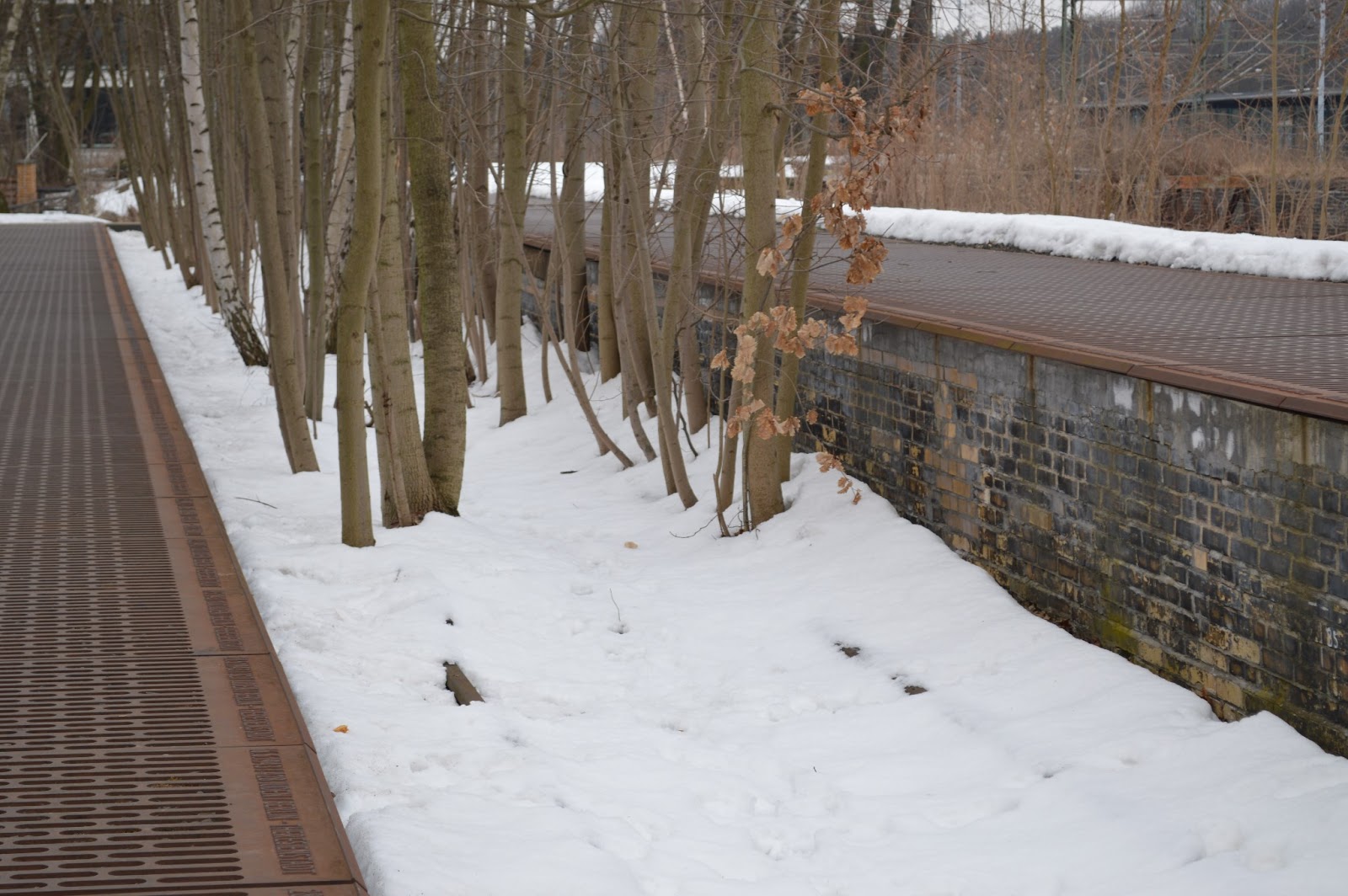
Our next visit was to the train station in Grunewald, a very wealthy residential area of Berlin. It was from this train station, beginning on October 18, 1941, that most of Berlin’s Jewish residents were to be deported. Olaf showed us three memorials at Grunewald to the deportation. The first memorial was a cross section of railroad ties in front of the entrance to the train station, established by a group of Lutheran women in 1987, with a plaque commemorating the beginning of the deportations. The second memorial was a wall which depicted figures as they walked up the hill to the train platform to be deported. The third memorial established by the German Railroad, was two platforms lined by plaques which represented each deportation train from Grunewald, listing the date, the number of Jews and the destination of the train, whether Theresienstadt, Lodz, Riga or Auschwitz.


After lunch at a nearby German restaurant we arrived at our final memorial destination for the day, the Wannsee House. It was in this house, located on the beautiful waterfront lake, Wannsee, that representatives of the bureaucratic agencies would meet on January 20, 1942 for a luncheon over which they would discuss how to carry out the plan known as the Final Solution. Olaf told us how after the war, though the city owned the Wannsee House, it was a property that was ignored until 1992 when they opened the exhibition about what had occurred here fifty years earlier. “Initially they wanted to forget,” he said. “Now they want to use it to educate.”
Inside the Wannsee House, which in 1942 was a house used by Nazi leaders for meetings and social gatherings, Mr. Barmore reiterated what he had told us yesterday about Nazi racial ideology; namely that the Nazis did not view their desire to eliminate the Jews from German society as emanating from any hatred of them, but from their ‘reasoned’ conclusion that Jews were essentially a destructive virus in the body of Germany and for its survival, they needed to be eliminated. “The Jews are our misfortune” was a common phrase used by the Nazis. To the Nazis, ‘misfortune’ represented ‘evil’ from a profound point of view.


Mr. Barmore told us the Nazis were therefore faced with a paradox: on the one hand, they wanted to eliminate Jews, but on the other, they didn’t have a clue as to how they were going to accomplish their goal. In 1933, he told us, Joseph Goebbels was asked if eliminating the Jews from society meant that they should be killed. Goebbels’ response, he said, was “What do you mean? We are not barbarians”. Yet in eight years, there would be 5 factories of death operating in Poland, with precisely that function. So how did they arrive at 1941, doing exactly what they could not conceive of doing in 1933?

We learned that it was a process which consisted of three phases, 1933-1942. Historians had long struggled to understand this process and they largely fell into two schools of thought. One school, the Intentionalists, believed that there was a straight line between Nazi ideology and the killings. The other school of thought are the Functionalists, who reasoned that if it was a straight line, there should be references to the killings in Nazi documents and writings as early as 1933, 1934, 1935, and so on. Yet they could not discern anything about annihilation in the reports of early years. The Functionalists, therefore, believe that Nazi policy evolved, a “Twisted Road to Auschwitz” , due to different circumstances, in three phases.


Phase 1 [1933-1939] focused on legislation and emigration of Jews. Early in the Nazi years, April 1, 1933, a one day boycott of Jewish businesses occurred. This was not orchestrated from above, by the government, but was an action of the S.A. and was unsuccessful and unsettling for the German people because it represented chaos at a time when they had elected a new government on the promise of law and order. Nazis therefore decided they must not allow mob activity to take over and decided to go about the process differently. They would first define who was Jewish, then take away the rights of those individuals and proceed against them in a legal, orderly way. No phase ended because it was complete, we were told, but because another phase started. For example, emigration did not stop in 1939; in fact, officially a German Jew could leave Germany as late as February 1943 if he/she could find a place to go. At this time, most Polish Jews had been murdered.
Phase 2 [1939-1941] focused on the period of concentration. When Germany began WWII with the invasion of Poland, there were 2.5 million Jews that Germany needed to deal with. Possible solutions discussed were the concentration of the Jews near Lublin, or shipping them to Madagascar, neither of which was possible. The Jews of Poland were concentrated in the larger cities into ghettos during this period. Mr. Barmore noted that this was a phase of the process which is unfortunately often overlooked in a discussion of the Holocaust, while the death camps are the major focus. He told us that the average length of time a Jew spent in a death camp was 2 hours. This is where they were brought to die. While the ghettos were the place that they lived --- for one, two, maybe three years. So a study of the ghettos, he reasoned, and their life in the ghettos, was a crucial part of Holocaust history. 

Phase 3 began June 1941 with the German attack on the Soviet Union. The Nazis understood that it would be a special war; one of competing ideologies and they prepared for that special war by establishing special units, called Einsatzgruppen or mobile killing units, prepared for a harsh war with Russian communists, partisans, and Jews who might be aiding the Soviet army. These units from June through December would be responsible for killing more and more Jews outside big cities, often with the help of local citizen, especially in the Ukraine and Lithuania who viewed themselves as not being conquered by the Nazis but being liberated from the Soviets.

After this happens in the Soviet Union, but only in the Soviet Union, the Nazis needed to decide what to do with the rest of the Jews and they started analyzing their options in October and November of 1941.   They reasoned that the mobile killing units were inefficient, and they were especially concerned that 20-30% of the members of the units doing the shootings had suffered mental breakdowns.  They needed to design an indirect, impersonal way of killing by industrializing it, so they developed the factories of death in Poland.   They had already experimented with carbon monoxide and zyklon B gas, and so they were ready to proceed, but they needed to figure out how it would actually be accomplished. Hitler’s deputy, Reinhard Heydrich was given that task.

The three phases in the Twisted Road to Auschwitz, 1-Emigration and Legislation, 2-Concentration, and 3-Annihilation were complete.  So how had the Nazis who in 1933  (Phase 1) responded that there would be no killing because they were not barbarians, arrived in 1942 (Phase 3) where they were, in fact, barbarians?  Mr. Barmore said there was one possible answer, and that was that war brutalizes.

However the Nazis came to be what they could not conceive of becoming when they initially came to power, Heydrich and representatives of the bureaucratic agencies which would be instrumental in the  murder of  Europe’s Jewish population delineated the process for it here, over lunch, in this house where we were now standing.


Video Clips


Student Reflections

Group 1 - Allie, Miya, Helen, Amanda, Kelly M., Kendall, and Max say ...

We felt the Grunewald Memorial was the most memorable and touching place we have visited thus far.  We have been seeing a lof of memorials but this one felt different. It was organic, not created after the Holocaust, but coming from the Holocaust.  For the first time we could really begin to picture the victims right where we stood.  Seeing the houses right by the station made us question how people could say they did not know what was happening.  Definately a sobering experience.

Group 2 - Alicia, Sarah, Bedros, Chris, Sam, Ashley, and Shannon say ...

Today we visited the Bavarian Quarter where we saw signs that memorialized the Nuremberg Laws and segregation of Jews in the Nazi era.  Everyday the German citizens of this region have to see these reminders of their country´s actions in World War II.  Unlike in Germany, Americans are shielded from the racial bias of their history.  Germany has acknowledged their past and  has provided visible representation of their awareness.  Additionally, it seemed to us that Berliners are hyper aware of their past. 
Group 3 - Alyssia, John, Kiley, Emma, Andrew, Guage, Juliana, Kelly B., and Meredith say ...

While we approached the Wannsee Villa, we were all in awe.  We were taken back by the beauty and intricacy of the museum, as well as the heinous events that occurred behind closed doors.  The conference room where the final solution was scripted made us unnerved, and made us all realize that moment was the means to bureaucractic justification for the end of the Jewish question.

Wednesday, April 3, 2013

Day 2 Berlin


At our debriefing and journaling session last night, we continued the discussion of memorials, again using familiar American memorials as a frame of reference.   In looking at memorials, Mr. Barmore explained, one needs to be aware of the various perspectives surrounding them.    One perspective is the essence of the memorial (whether it be to an individual or an event), but another significant perspective is that of the individuals, group, or nation which established the memorial.  It represents the personal or historical story yet also reflects the perspective of how those who created the memorial see that story, and as such, reflects who they are and how they see themselves in the context of that event.  Memorials are therefore subjective representations. 

We ended our evening discussion with some observations and a question – to further complicate our thinking.  Memorials are about memory, but a concise, pointed, powerful image.   They can be provocative, though, and impact our intellectual thinking and foster discussion about the topic of the memorial.   Mr. Barmore lastly posed the following question as food for thought:  History is complex….can a memorial be complex?  

After breakfast, we began our day on our bus where Mr. Barmore  gave a lecture which began with a question.   Inasmuch as Germany had a rich history and was an important international cultural center by the 20th century,  “Why did the Holocaust happen here?”    This question, he told us, was both a specific, particular question relative to the Nazis, but also a universal question, because it could potentially happen anywhere given certain circumstances.  The Holocaust, therefore had been studied by psychologists to determine if it was something in the German character which had allowed this to happen; by historians to find out the incremental steps which had led to the Nazi dictatorship; by sociologists who checked things like children’s stories ---all in an attempt to understand ‘why.’


Mr. Barmore told us that our first stop today would be the German Historical Museum where he would show us some highlights of German history in an attempt to provide a framework that would contextualize the Holocaust.   That, in and of itself, he said, was difficult because if one accepts the assumption that German history defines the German people, how does a museum present that history as something which led up to what that society did?  And, he noted, German society does take responsibility for its history and the Holocaust.  The Holocaust is not the only thing that defines Germany, but is a part of her history that she is not afraid to confront and examine. 


Mr. Barmore then posed a second question:  “Why the Jews?”  As less than 1% of German society, how did German Jews become the primary target of the Nazis?   He said that one explanation was that it resulted from the collision of two special histories and that though Jews were less than 1% of the population, they were visible and important in German society.   We would be viewing historical events in German history in the museum, not to in any way justify what the Nazis did, but to try to understand the crisis in Germany created by World War I and understand the message that the Nazis brought to the German people which led to their rise to power, despite the fact that Hitler was looked down upon by the German people.   In order to understand the complexity of Holocaust history, we would need to examine the rise of nationalism in Germany and the role of the Jews in that society.

At the German Historical Museum,  Mr. Barmore again used the United States as he had yesterday, to explain some of the differences between the concept of nationalism as it developed in Europe and what we would call ‘American nationalism’.   America, he said, is a civil state --- the Founding Fathers laid out in the U.S. Constitution the structure and role of the government which was created in the name of the people.  The purpose of the state is to guard the civil rights of the citizens and the government officials in America are our civil servants; there to serve the interests of the people.   In contrast, in the European historical evolution of the context of ‘nation’, it is something  greater than its people, something vague and difficult to define.  The nation will be personified by a symbol in order to simplify it .  France would be symbolized by the female statue, Marianne, Britain by Britannia, and Germany by the statue,  Germania.   And under fascism, the state would become an absolute;  the role of the individual in that society was to serve the state.

As we continued through the museum we learned that during the Romantic Period,  many aspects that gave identity to a people, such as language, literature and music, would become specific to that nation.  In this way, Shakespeare’s plays became not just literature, but English literature, and Beethoven’s music would become German music.  While Germans were lacking in terms of geographic unification, they developed a sense of cultural unity which defined them.

 Later, when the Nazis came to power, a spiritual component to nationalistic pride was added, so that Germans became superior not just physically but spiritually, which manifested itself in creativity.  For the Nazis this superior creativity would be attributed to race.  If a German lost, it was not that another individual won, it was that the German had not lived up to the criteria of racial superiority.   And when Jews became emancipated they entered the middle class, became economically successful and fell in love with German culture --- what Mr. Barmore called a “one-sided love affair”.   While Jews felt assimilated, eventually German racism would hold that Jewish contributions to German culture were not creativity, but a vulgarization, cheapening or copy of that culture. 


As we went through the museum, Shalmi pointed out the importance of Versailles for the Germans. Following their victory in the Franco Prussian War of 1871 the emperor of Prussia (Germany) was crowned. However, after the fall of the empire, immediately after World War I, Versailles has a new meaning for the German people. This became the place where they received the official recognition of their defeat, and were punished by the Versailles Treaty. Before World War I, the military consisted of officers who were from the upper classes. After the trench warfare of World War I, the soldiers who emerged from the trenches entered a new society in which all were equal, war equalized them under the flag and for the first time you have a combination of socialism and nationalism.

 Our time at the museum ended as our day had begun, with a question posed by Mr. Barmore.  Nazi racial ideology claimed that not only was there a superior race [Germans] and inferior races [such as Poles and Slavs],  but a third race, Jews,  which had penetrated German society and was actually a destructive element in German society which would cause the German race to become extinct.  Nazis then reasoned that this group had to be eliminated from Germany in order for the German race to survive, but the paradox was:  What did it mean to eliminate the Jews?  In 1933 there was no question of killing the Jews, so what led them to that process?

From the museum we went to the Otto Weidt Workshop for the Blind. In this factory, students heard about the blind and deaf employees who made brooms and brushes from horse hair and pig hair. Otto Weidt also employed Jews, and used the Berlin Work Act to legally keep employing his Jewish workers during the war. Otto protected his Jewish employees as well as a Jewish family of four which hid in a secret room built behind a secret wardrobe closet.  After eight months of hiding, the family was betrayed and deported to Auschwitz, where they were all murdered.  Our guide explained how Otto Weidt helped an employee, Inge Deutschkron, who is the survivor who returned to Berlin after the war and preserved and documented his rescue efforts as a tribute to the memory of this heroic man.  Inge still lives in Berlin and at age 92, occasionally teaches about this important history  at the museum that she single-handedly established, memorializing the rescue efforts of Otto Weidt. 

After lunch we continued learning as we walked to the Old Neue Synagogue, which was built over a six year period and consecrated in 1866.  The  beautiful Moorish building style and the large Schwedler Dome of gold, shaped the silhouette of Central Berlin,  and was a symbol visible to all of the self-confidence of the Jewish community.  During Kristallnacht, in November of 1938, most of Berlin’s 14 synagogues were burned, but  Wilhelm Kratzfeld, the Berlin police officer responsible for the district, was able to preserve the synagogue from major damage by chasing away the arsonists and calling the fire department.  The synagogue was able to resume services in April of 1939 and the last services took place in March of 1940 at which time the synagogue became a storage place for documents and records.  Allied bombs severely damaged the synagogue in 1943 and in 1958 the main synagogue was blasted in what was then East Berlin.  Nine of ten synagogues in West Berlin were blasted and three of four in East Berlin were also blasted.  In 1988 a seven year reconstruction project was undertaken and the synagogue opened as a museum in 1995.

Our Berlin guide, Olaf, told us about the first female rabbi, Regina Jonas, associated with the synagogue.  During the war she was deported to Theresienstadt and then to Auschwitz where she was murdered at the age of 42.


Following our learning about assimilation of the German Jews, Olaf also showed us two Torah curtains.  The writing was in Hebrew but had been used to write a Psalm in German, Psalm 89:15  “Justice and judgment are the habitation of thy throne and mercy and truth shall go before thy face.”

We lastly learned that at the end of the war, less than 7,000 of the 160,000 Jews who had lived in Berlin were alive.  Today there are 10 synagogues and about 10,500 Jews in Berlin, primarily from Israel, Russia and Poland. 

It was bitterly cold so our bus took us to our final stop of today, the memorial at Rosenstrasse.  In February 1943 a group of German Aryan women stood in front of the building at Rosenstrasse 2-4 which had been a Jewish Welfare Office but now serviced as a detention center for Jews who were to be deported east.  These women were all married to Jewish men who had been rounded up under Joseph Goebbels’ orders.  Goebbels wanted to clear Berlin of all Jews in time for Hitler’s birthday and make Berlin ‘Judenrein’  as a gift for the Fuhrer.  For one week these women stood in front of the building and chanted “We want our husbands back!”    The Germans set up machine guns and threatened to fire upon them, but the women would not relent.  Finally, the Nazis released all of their husbands, even bringing back two of them who had earlier been sent to Auschwitz.   The memorial depicts the events of this week in February and the heroic efforts of these women to have their husbands released.  These Jewish men were able to live out the remainder of the war in their homes in Berlin.  The students reflected that the memorial  depicted camaraderie, strength, the women’s support of each other, their common cause, the separation of their families --- another concise, powerful image of an important event.  Mr. Barmore made one final observation to us:  There were many non-Jewish women across Europe married to Jewish men;  this type of resistance only took place here, adding to our sense of complexity of the history surrounding the Holocaust.


Student Reflections

 
Bedros says:
Though this day has been surreal to me, and the magnitude of being in Germany has yet to grip me, I have realized an uncomfortable truth.  This being that when a group of people have nothing, they may often look to blame another for their strife. This concept has been a personal internal struggle for me. Today, I have come to the realization that the consequences of scapegoating can be destructive.

Alyssia says:
The one thing that really caught my attention today was Otto Weidt`s Workshop for the Blind in Berlin.  When on the tour of the museum I felt very emotional when learning about the effect that one German man had in saving the lives of so many Jewish people.  It made me realize that even though society has taught us, for the most part, that all Germans were passive during this time, there were Germans that were against the mistreatment of the Jewish people and it was truly touching.

Meredith says:
Today when we were at the German Historical Museum we talked about how many Jews tried to assimilate beyond their German past.  It made me think about being Jewish in America and even though I am not trying to erase my personal history I am just like any other American teenager, I do not go out of my way to associate only with Jewish families.  Some of my best friends are Catholic and we do not think twice about the fact that we are different religions.  Today just made me think that assimilation was the goal for many German Jews, but because of the societal attitudes of the times, they were never able to achieve full assimilation as my family and I have done in America.

Andrew says:
 It really stunned me how the Jews were not accepted into German society once the Nazis came to power even though many of them were at the top of their fields in music, business and highly assimilated in German culture. During the period of the Holocaust they wanted to be accepted as they had been before, but Nazi ideology kept this from happening.  They truly wanted to be German.  As Olaf said "They, the Jews, were never really invited to 5:00 o'clock tea."

Mia says:
Many subgroups in modern society are criticized for not putting enough effort into assimilation.  Immigrants are often considered leeches in their new countries.  At the German Historical Museum we learned that the Jews took an approach which strongly subverted that stereotype by being fluent in German by the second generation, changing their names, and being active participants in German commerce and culture.  No matter how assimilated they became, they always remained a part of "a one-sided love affair" in that they were not accepted based on race. Coming from a nation of immigrants it is hard for me to truly understand why people who attempted to German society would be rejected.  The issue we face in learning about the Holocaust, is that it is as much about assimilation as it is about acceptance.
 
Juliana says: 
At Otto Weidt`s Workshop there was more than just the aspect of hidden Jews that was touching.  Otto not only housed Jews he even sent packages to a Jewish friend who was sent to Theresienstadt.  Otto was well aware of the consequences for hiding and aiding Jews, and yet he did not stop his actions.


Tuesday, April 2, 2013

Day 1 BERLIN

There's snow on the ground in Berlin as we began our adventures.   Bishop O'Dowd students had arrived yesterday afternoon and were able to tour the dome of the Reichstag building this morning while waiting for the rest of our group from New Jersey who arrived this morning.  We all met up at our hotel this morning and after brief introductions we were off on our day.  Our local guide, Olaf, took us first to the Central Airport which had been built by the Nazis and which later served as the airport for West Berlin until the unification of the city in 1989.   We were challenged to analyze  what the building could tell us about the identity of the people who had built it.  Mr. Barmore  led the discussion about the straight lines, the uniformity, and the symmetry, all values which were important to the Nazis. 

Our tour of Berlin continued as we went from the former West Berlin into East Berlin, passing through one of the three checkpoints which had served as links between the two sections of the city.  The checkpoints had been named Alpha, Bravo and Charlie.  We passed through the most famous of these checkpoints, Charlie, which has become more of a tourist attraction than many residents of Berlin prefer.  Olaf reminded us that many Germans who were living in the Soviet zone of Berlin, which would become East Berlin, were killed, trying to escape to the West Berlin zone. 
A new exhibition is being established to serve as a reminder to all visitors of these events.

We continued our drive through what was East Berlin, and Olaf pointed out sites such as the Berlin City Hall, the Jewish Museum which we will visit later in the week, and Aleksandrplatz, where thousands of East Berliners demonstrated during the Velvet or Peaceful Revolution in 1989. 

On the famous Museum Island, we  saw several museums which had been constructed under Frederick the Great, King of Prussia, and we learned how, at that time, Germany was, in fact, more than 300 dukedoms and municipalities.  Mr. Barmore spoke to us about how Frederick the Great wanted to unit these smaller governmental units and unify them into a united, modern nation of Germany and the practical difficulties of achieving that goal.  There ensued a discussion of "American nationalism" and what we believed that meant. 

 Ideas that were offered included:  freedom, wealth, the American Dream ........all of which Mr. Barmore told us, were individual goals, whereas in Europe,  when people are asked about nationalism, they tend to go immediately to their history and tradition, which provide a more collective identity.  When Frederick wanted to gather those with similar traditions into one nation, the most common and most important of those traditions was language, so he attempted to unite by force  those people who spoke German.  The Nazis would later attempt the same thing, trying to identify and define their nation by something which didn't actually exist.....a common 'blood'.

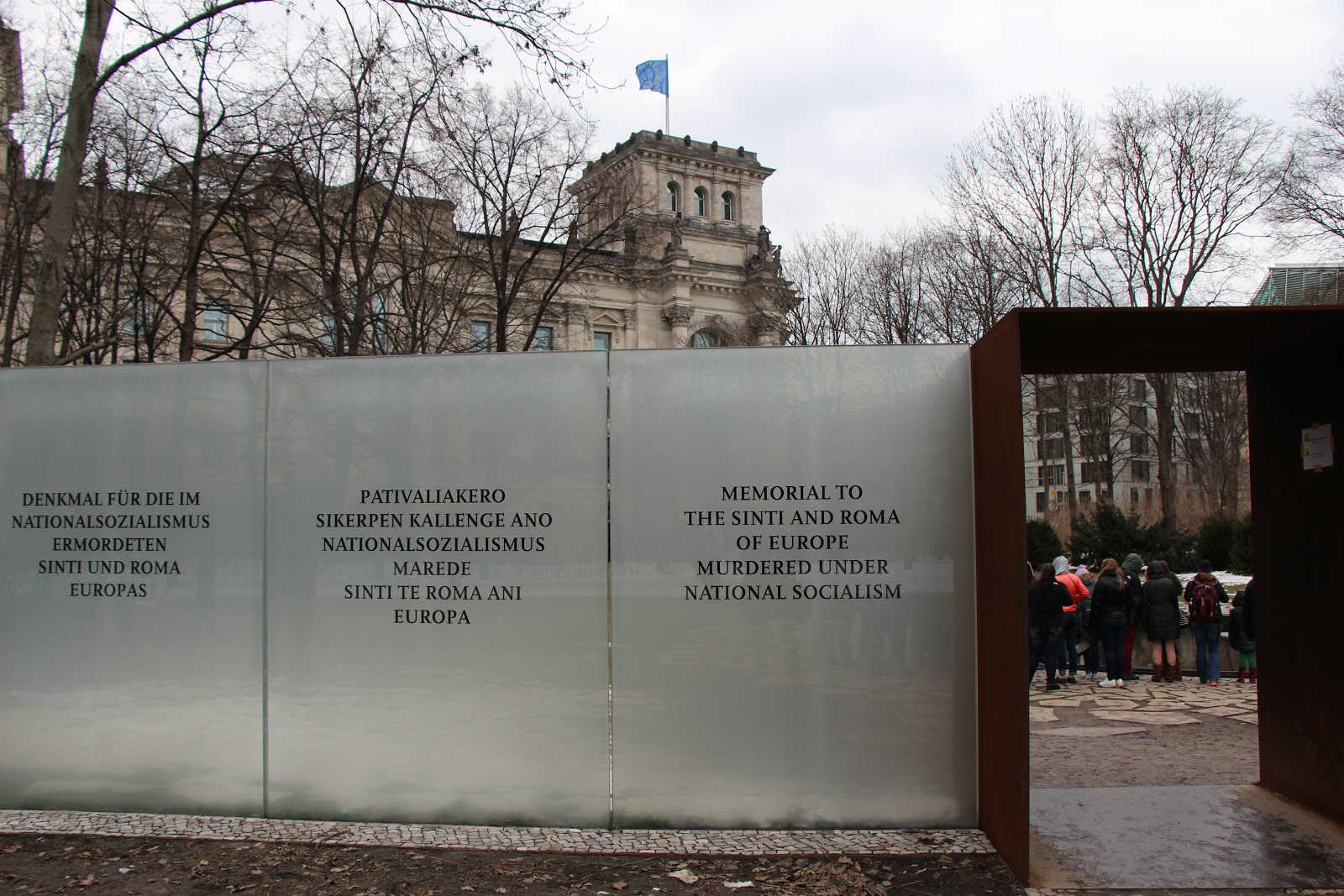
Our next stop was the Memorial to the Murdered Jews which is a city block on which are 2711 blocks.  We talked about what these blocks might represent to various visitors, the structure of the memorial, and what the architect might have wanted to achieve with his unique design. We then proceeded to two adjacent memorials to other victim groups in the Holocaust.   Across the street was the memorial to the homosexuals who were victims of Nazi persecution and a little farther down the street was the memorial to the Sinti and Roma victims, more commonly known as Gypsies.  Both of these memorials were distinct and we discussed the role of memorials. Is a memorial intended to bring understanding to an event and educate the visitor?  Is it intended to cause the visitor to ask questions and keep the event alive in our memory?  These memorials are all considered modern memorials which are often more interactive, disturbing, and thought-provoking. 

                                                                      After lunch at the Potsdamer Platz near our hotel, we proceeded to our last stop of the afternoon, the Topography of Terror, a museum which attempts to answer the question "How was it humanly possible?"  by taking us through the bureaucratic process of the Third Reich on the site of where many of the offices so instrumental in the Holocaust stood. 
We headed back to our hotel to check into our rooms and freshen up before dinner at our hotel.  After dinner we will be reflecting on the day's events and have our first journaling session before heading off to get a good night's sleep which the New Jersey students, especially, are eagerly awaiting.  Students will be posting their individual reflections on our blog beginning tomorrow.


Monday, March 25, 2013

This year's Holocaust Study Tour will begin on April 1st. Please look for our first post, Day 1 Berlin, on April 2nd. We look forward to sharing our experiences with our followers.