The Holocaust Study Tour is an educational tour that motivates and challenges students to rethink one of the most horrific events in history. Traveling through Germany, Czech Republic, and Poland, students make meaningful cultural connections to the people and nations they visit. Read below to learn more about the trip and it's purpose. To make a donation, make checks payable to NMHS School Activity Account. Mail to: NMHS One Snyder Circle New Milford, New Jersey 07646
Sunday, March 25, 2012
Day 1 Berlin
Sunday, March 18, 2012
Holocaust Study Tour 2012
Friday, April 22, 2011
Day 12 - Krakow
Today we spent the day with our guide, Ewa, walking and learning the history of Krakow and the Wawel Castle district. After walking through the square, we walked up the hill to Wawel. The flowers are in full bloom everywhere, on this sunny, beautiful day.
We enter the Wawel Cathedral, and silently walk through, since many people are inside praying today, Good Friday. Here is the burial place of Polish kings and rulers. We visit downstairs, underneath the cathedral, where the sarcophogus of Jan Kazynski and his wife, who were killled in the plane crash last year at this time.
From here, we walk down the hill toward Jagellonian University, the oldest university in Poland. We enter into a guided tour of this place, where students once included Copernicus and John Paul II.
From here, we go back to the square, and enjoy and afternoon that includes lunch and shopping for souvenirs from beautiful, hospitable Krakow.
Sarah S. says ... The Holocaust Study Tour was definately an experience I will never forget. I laughed, I cried, and discovered my identity. I have gained more knowledge of my heritage, more common sense, and more friends. Celebrating a Jewish holiday in a Jewish community in the Czech Republic was the highlight of my trip that will stay with me forever. Thank you to all of the teachers and my family members for making this possible, but most of all, my grandfather.
Sammy says ... Going on this trip and learning as much as we did was truly a life changing experience. We haven't even gotten home yet, but I know I am going to be an entirely different person. I will never forget all that I saw, everything that Shalmi taught us and all that I have learned about myself.
DaiQuan says ... The Holocaust Study Tour trip gives an opportunity to students to learn the history of Europe. It gives students an opportunity to change minds for the better. This trip gives knowledge and emotions to empathize with people who were persecuted during the Holocaust.
Lilibeth says ... This trip is a milestone in my life. It gave me the power and inspiration to change myself and the world around me. It has given me the knowledge and power to give hope to our new generation and keep our history alive and well-known.
Kasandra says ... Just like what I had intended it to be, this trip has opened my eyes to a whole new world of so much history. It taught me about not only the Holocaust, but the history of visited cities, and how much we take for granted. These past two weeks brought me to the conclusion that this is a once-in-a-lifetime adventure and I am so grateful to have been a part of it!
Mackenzie says ... Unforgettable -- that is the best way to describe my experience. The Holocaust Study Tour taught me more than I ever hope to know about not only the Holocaust, but also the European countries involved at the time. During two intense educational and exciting weeks, 22 students, 4 teachers and Shalmi came together to form a tight-knit family of which I am so grateful to be a member.
Jordan says ... I have been so lucky to have the opportunity to go on such an amazing trip. I have learned so much more about the Holocaust than ever before. This trip has changed my outlook on life and inspired me to continue my learning about the Holocaust.
Thursday, April 21, 2011
Day 11 - Krakow
Inside the Stara Synagogue in the Jewish Quarter, we learned about the history of Hasidism, a part of Judaism that reflects emotional piety of the people who practice it. From here we visited the Remu Synagogue, where Shalmi explained the first hyperlinks, contained inside religious texts. Outside of this synagogue, we walked through the Jewish cemetary, where Jews were given land to bury their dead.
As we walked down the sidewalk, Shalmi ran into a friend, Jonathan Ornstein, the director of the Jewish Community Center (JCC) of Krakow, who invited us inside his center. He explained that the primary function of his center is to promote a thriving Jewish community, only 40 minutes from Auschwitz, where the doors are wide open to anyone who wants to come in. This center, dedicated in 2008 by Prince Charles of Great Britain, shows an optimism, and even though some of the members lived through the Holocaust, and are Holocaust survivors, the label isn't all that they are. They are people who overcame, and went on to have families, professions, and most importantly, they live.
After a quick lunch at McDonalds, we went to the Jewish Ghetto of Krakow. The Nazis forced the Jews to move away from their Kazmierz neighborhood, to a section of Krakow across the river. This ghetto was a sleeping ghetto--Jews left during the day to work in factories. From the museum that once was the pharmacy of Tadeusz Pankiewicz, we looked out over the open memorial, with chairs, that represent the furniture that the Jews carried over the bridge into these cramped quarters, where 17,000 people crowded into 320 houses.
We ended the day at the Plaszow Camp, which was built by the people from the Krakow Ghetto who believed they would survive the war because they are building a labor camp. They even built a barrack for children there, so they believed that their families would remain intact. However, on March 13, 1943, all Jews from the ghetto were supposed to report to the square at 7:00 a.m. Once there, all children under age 14 were told to line up separately. Their parents were told that they would come to Plaszow the next day. Those who didn't believe them rushed to the pharmacy and purchases one of two drugs: 1. Valerium--a drug that put their babies to sleep, so that a few parents could smuggle their babies into the Plaszow camp. 2. Cyanide, for suicide. At 1:00 p.m., the Nazis ordered those not in the children's line to start marching from the ghetto to Plaszow. They left behind what they were unable to carry. Their children were taken away and shot. Two days later, some parents were forced to sort the children's clothing, and found the clothing of their own children.
Who would have thought, even for a moment, that our day in Krakow would end with us inside the villa of Amon Goeth, commandant of Plaszow Concentration Camp, where Spielberg filmed parts of Schindler's List? After visiting the area of the camp where today lay the ruins of the Jewish Burial Hall and a memorial to Sarah Schenirer (this is the area of the camp that the HST 2009 participants cleaned up), we walked to the villa of Amon Goeth. While looking at the house from the street, we saw a gentleman come out of the doorway and wave us up the walkway. We, of course, approached the house with Shalmi and Ewa, our Polish guide, and immediately took him up on his offer to come inside. This man is the current owner and resident of the villa who is hoping to sell the house to the museum community of Krakow. This was an incredible chance meeting that demonstrates the importance of experiential learning and its possibility for rare opportunities that become profound teachable moments. Shalmi, Ewa and our group have never been inside the villa because it is privately owned. How fortuitous that we were walking down the street and the owner happened to see us standing outside his house and welcomed us inside.
After this completely surreal experience inside Amon Goeth's villa, we returned to the hotel to say goodbye to our historian, our guide and our friend, Shalmi.
Wednesday, April 20, 2011
Day 10 - Auschwitz
After breakfast, we load our luggage on the bus, and drive the short distance to Auschwitz I, which prior to the Holocaust, was used as a military base by the Poles. Our guide tells us that the only thing the Nazis had to do to turn it into a concentration camp was to put up the fence. We pause at the gate, again reading the sign "Arbeit Macht Frei" and learn that here, prisoners played music as their fellow inmates marched to and from work sites. This made it easier for the guards to count them as they exited and returned.
After lunch, we go to Birkenau. As we pass through the gate, Shalmi, again guiding us through our Holocaust journey, points out The Ramp. Memories of those who survived Auschwitz/Birkenau were divided in two: life before The Ramp, and life after The Ramp. The Ramp is as much a part of Jewish history as Mount Sinai--which is where according to one rabbi, Jews should have taken God to account. Here Jews can echo the words that were written in the hidden synagogue in Theresienstadt: "God, we remembered you. Don't forget us." The rabbi felt that because of the Holocaust, the original covenant between God and the Jewish people should be renegotiated.

Birkenau reflects a modern way of killing. No one person is the actual killer. People do their own little part and feel disconnected from the process. Each person plays a part, from the train conductor to the person who opens the railcars, to the SS officer doing the selection. People do their own little part and feel disconnected from the process. They don't see themselves as killers, so who should take responsibility?
Mackenzie says. . .Entering the gates of Auschwitz, everything felt incredibly surreal. After years of reading books, looking at pictures, visiting musuems, and watching movies, passing through the gates of Auschwitz was truly the defning moment in my study of the Holocaust. From touching the original rusty barbed wire to seeing the seemingly endless pile of human hair, I have never felt such an overwhelming stream of emotion overcome me. However, the single-most unexpected thing that genuinely stuck out to me the most was a simple cheesegrater. While in the room filled with kitchen utensils, I came across a cabinet that contained an average household cheesegrater. I found myself staring at the item for several minutes--completely entranced by its strange familiarity. You see, it was at this very moment that I realized this was the exact same cheesegrater we have in my very own home. Though silly and trivial, this simple item was a physical representation of how innocent and truly humane the Jews and other victims were. Though I am not Jewish, I connected to the Jews, for that cheesegrater exemplified the idea that no matter what, the Jews were normal humans just like me. Seeing such artifcats, observing the gas chamber remains, and passing under the infamous "Abriet Macht Frei" sign all epitomized the overall notion that the Holocaust was undoubtedly a question of humanity in the world.
Celina says. . .There was one photo on the wall of the women’s barrack, where the woman looked defiantly into the camera with an expression that said “You will not break me." Amidst hundreds of broken faces, her name was Wanda and she only survived a few short weeks in Auschwitz. The only Wanda I could think of was the movie A Fish Called Wanda, which is my mother’s favorite movie. It made me think of how my mother would be equally defiant behind that camera, and if I could stare down my oppressors with just as much spirit as my mother and Wanda.
Sarah S. says. . .The fact that my grandfather and his family could have been working in the concentration camps or sent to Birkenau, the death camp, really hit me hard. These were real people with real stories with the vast are that our group witnessed today. There were approximately ten members of my family that perish in camps, but their stories are unknown. If my late grandfather hadn't escaped and survived I would not be here today. In a way the journey through Auschwitz made me feel a sense of relief that I am alive; however, it left me with sorrow for those in my family who did not. The importance of continuing this history is a life long journey.
Lilibeth says. . .As I entered Auschwitz II known as Birkenau, I saw this beautiful place that held many terrible , horrible stories. Seeing the flowers all over the camp, I saw it as a way nature gives its condolences to all the deaths that happen in these camps. I see it in this way because their deaths were never given the respect they needed or should have been given.
Deanne says. . .Auschwitz had to be the most uncomfortable place I have ever been in. Walking through this huge camp I tried to imagine myself in the shoes of the victims in the Holocaust. Seeing real shoes, hair, train tracks, barracks, train cars, and crematoriums I started to get queasy. Words can’t even explain the sickening feeling I had knowing that I was in a camp where such horrible terror took place.
Cherilyn says. . .As I was sitting in the area called “Canada,” looking out at Auschwitz II, I began to think about my birthday, and I started to think about the birthdays of the prisoners. I began to wonder how the prisoners would have felt on their birthdays. Would they be happy to survive another year, would they wish they were dead and no longer suffering, would their wish have been for freedom, or would they have been too numb to feel anything? I thought of how many people would never celebrate their birthday and how many children would never reach their seventeenth birthday. I almost felt guilty that I could recognize my birthday and they never would again.
Nick says. . .While in one of the tattered women’s barracks of Auschwitz-Birkenau, Shalmi told us the story of Sila, a barrack Elder that allowed power to corrupt her previously kind, pious self. Sila was originally a fragile, gorgeous young sixteen year old Jewish girl when she first entered Auschwitz, but like for many other Elders and Kapos, the traumatizing camp life transformed her genial persona into a cold-blooded one – one focused only on self-conversation and survival. She had managed to undergo a monumental transformation within two years, changing from a kind young girl to a ruthless, callous woman.
In the story lies a lesson of human nature. When exhaustion becomes overwhelming, fear of death constant, and hunger ravenous, people change from benevolent humans to selfish animals. Deep down, all of humanity holds basic animalistic instincts – instincts that care only for self-conservation, even if the preservation of one’s self entails killing for bed space, killing because an SS officer said so, or killing for a small piece of bread. We can all “degenerate” into real animals if our lives truly depend on it, clear in the camp life of Auschwitz.
Ashley says. . .When I saw the two tons of human hair, tears filled my eyes right away. Looking closely and seeing the different types and colors completely blew me away. I became so overwhelmed looking at the full braids that had been cut off girls’ heads and used to make rugs. I wore a braid today and I was so disgusted knowing that the hair in that glass case was exactly like mine.
Sarah P. says. . .Each pair of little feet came to Auschwitz in a small pair of shoes. These shoes weren’t ready for a long train ride or toe tapping with suspense as an officer chose the fate of family members. In a crowded room, many got ready for a shower and the little pairs of shoes were taken off and hung on an offered hook. Walking forward, 10 little toes had no rubber soles to cushion the walk through the tall crowd. As they believed the small pairs would be dangling from hooks when they got back, many pairs were left without their original owner.
DaiQuan says. . .As I began to walk into a camp named Auschwitz I and Auschwitz II, I began to feel alone without my freedom to live. When I was walking in both camps I was trying to picture these actions taking place as we were told the story. Some of the people were told lies about where they were going. Also when the Jewish people were told to take off everything it made me think how bad they were treated, like animals and not humans.
Brenton says. . .On this very day, we ventured into the vast area where the former death camp existed during the Third Reich, known as Auschwitz-Birkenau. As I approached the intimidating entrance gate to the camp, a feeling of fear overrode my body. No matter where I was walking in Birkenau, watch towers stared me in the face, each spaced evenly 100 meters around the perimeter of the camp. As our group started to walk away from Crematorium III, I looked to my right, and observed a long chamber where victims took off their clothes, and at the end of it sat the ruins of the crematorium. Just to know how many people lost their lives right where I was looking is almost unimaginable because one would not want to believe that these atrocities occurred.
We ended the day with a celebration for Cherilyn's 17th birthday ! Happy Birthday Cherilyn !!
Day 9 - Part II - Auschwitz
Tuesday, April 19, 2011
Day 9 - Trsice
After the presentations we stopped briefly in the town’s museum and met with its curator, Mr. Sehmalek. In a large book, students were asked to sign their names under their school name so that the town could add pictures and a story about our visit. In this small museum is also a display about the Wolf family and as we studied the photograph of Lici Wolf, we noted the striking resemblance between Lici and her grand-daughter, Helen, who we had met in Prague a few days earlier.
We next walked to the restaurant where the town hosted a lunch for the entire group which consisted of Czech meatball noodle soup followed by steak with gravy and an egg on top, fries, ham, and purple and white cabbage. During the lunch they gave every one of us a present: a light blue T-shirt sporting the Trsice frog, the town symbol, which is derived from the name of the landlord of the area whose name in Czech translates to “frog”.
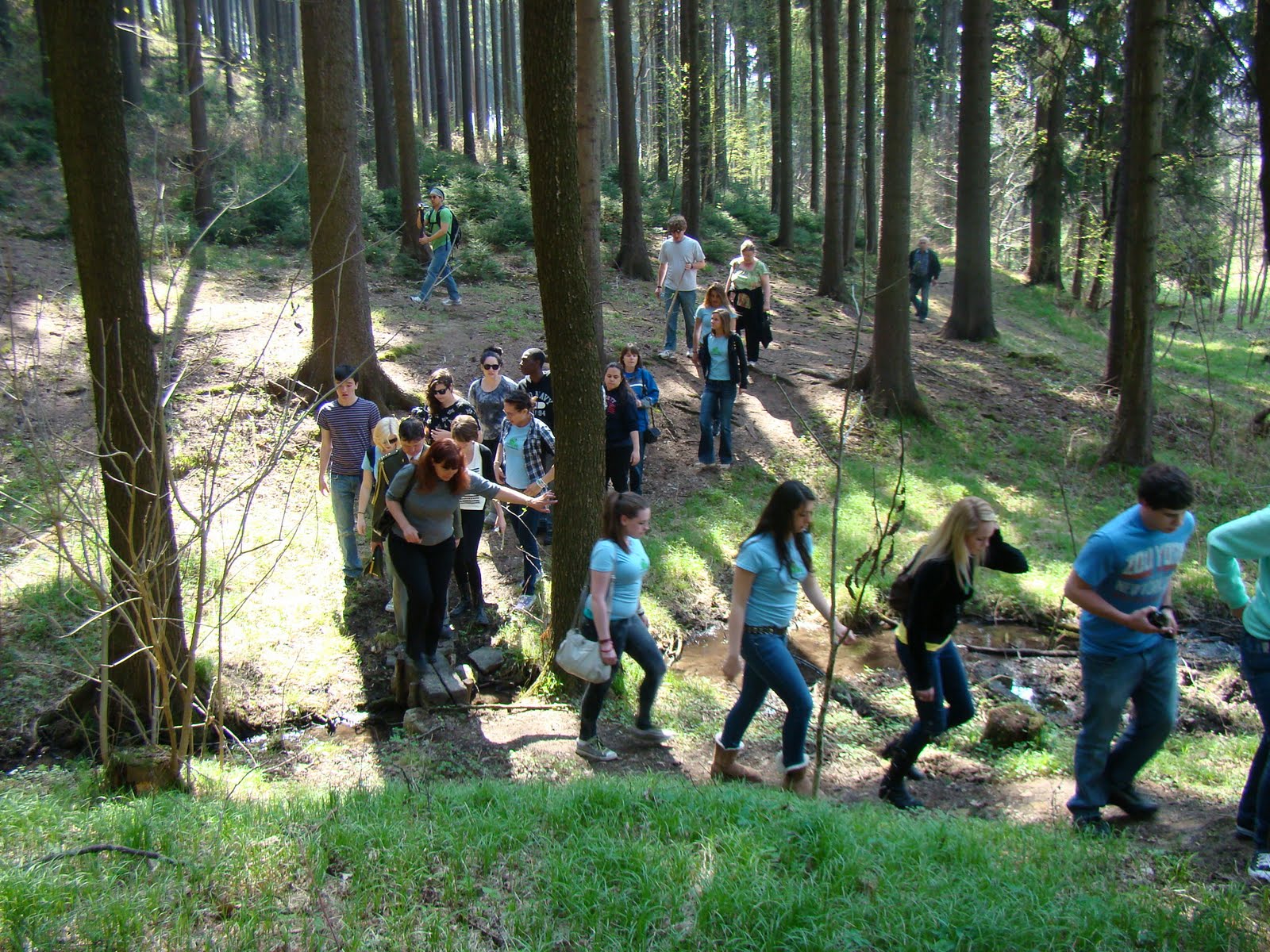
Our next stop was the house where the Wolf family lived before the war. Mr. Wolf had done accounting work in Trsice and he decided to move his family there in 1939. Crossing the bridge over the stream where the Wolf family washed their clothes while hiding in the forest, we climbed the steep path into the woods. Although some timber has been cleared in the last four years since our group first saw the hiding place, we still get a sense of how dense the trees once were and how this frequently became a dark and secluded hideout for the Wolf family. We had the sense of how scary it must have been for the Wolf family at night to hike out to get food and water and wash their clothes; how physically close it is to the village but how, when you are in the forest, you feel totally isolated.
Our final stop in the area was the small town just next to Trsice, Zakrov, where the Wolf family was hidden by several families during the war, including Mrs. Ohera’s family. As we stood before one of the windows of her childhood home, Mrs. Ohera explained that as a child even she had not known that her parents were hiding the Wolf family. She also described the night of April 18, 1945, when soldiers raided the town and rounded up nineteen men, including Otto Wolf, her father, and her future father-in-law, as a response to increased partisan activity in the area. These men were tortured over the next two days and then were driven into a nearby forest on April 20th and executed. Zakrov does not have its own cemetery so the victims are buried in the cemetery of Trsice, but the town erected a memorial to these victims. Each of the names is listed on the memorial with a photograph, and we noticed the resemblance between Otto Wolf and his niece, Eva, who had spoken to us in Prague earlier, about her mother, Lici.
Throughout the entire day, our Czech guide Ilona Zahradnikova from Prague, was indispensable. As the sole interpreter for the group, she did yeoman’s duty as she translated stories and questions from Czech into English and English into Czech.
We bid farewell to our hosts, promising to return next year to establish the memorial to the town of Trsice for its rescue efforts, and climbed on the bus for a three hour ride to our next destination: Oswiecim, where tomorrow we will visit Auschwitz.
Ashley: Mrs. Ohera - because even though there was a language barrier, it didn’t matter because through her emotion and her voice you could hear. It was a tragic time for her and she remembers specific details to the point that it didn’t matter …you got the gist of it.
Sadie: The hideout in the woods – because my perception was that we weren’t going to really see anything, but when we got there we saw the two giant gaping holes where the Wolf family hid. And the fact that they hid here for three years was so strange and hard to believe for me.
Lily: The pathway to the hideout - because I compared it to a pretty girl who has been through hardships; within is dark terror, but people still say she’s pretty. You have to look within – for example with people, you don’t know what’s going on in their minds or their homes; people go through many obstacles in life. The same is true with the woods; it’s a regular forest but within there’s a history and past terror
Cherilyn: The woods around the hideout – because I kind of picture myself in the Wolfs’ place, walking where they once walked, and it’s remarkable to me.
Reagan: When Mrs. Ohera took us back to the spot where she had lived, and went through every detail of this traumatic event in her life. It’s really rare; takes strength to go to the place where her father was captured and tortured and recount every detail so we could understand what it was like. It was so moving, chilling, listening to those details.
Kassandra: Mrs. Ohera – because she went through such terror and fear. I tried to put myself in her shoes but couldn’t – to be able to tell such a story. When at the house where she lived, I saw tears on her face, and couldn’t stop listening. It was so overwhelming at such a young age to go through that.
Brenton: The Colonel from the Czechoslovak Legion – So many things go through your mind like the Nazis being in uniform and though the Czech uniform was different I thought of the role of the military.
DaiQuan: Lunchtime – because I felt like we were all part of the Wolf family. We all came together to eat a meal after they told us the story; it was like a family.
Jordan: The hideout - because being there and knowing what they went through in the tunnels and the luck with meeting all the right people who could help them – that was amazing!
Nick: When Mrs. Ohera took us to her childhood house – because the image of how the soldiers were sticking guns in her mom’s face and her mom holding their hands hit me. I thought of my mom and me and my brother holding her hand – I wouldn’t know what to do in a similar situation.
Celina: Hiking through the forest - because I saw a guy in a WW2 outfit on the hill against the background of the forest and I thought, “that’s how it would look when the Wolf family was there”. I know the guy was actually wearing a Czech uniform, but they were similar. It was kind of surreal – I almost felt like I was there watching a soldier looking for the Wolfs.
Sarah P: A series of moments resonated for me. In the beginning Mrs. T greeted Mrs. Ohera and I saw her face when she was doing that; I hadn’t understood how important it was for her [Mrs. Ohera] to bring students to hear her story, and later, by her house, when she was telling us things that had happened to her family. A museum or textbook can’t tell that raw story or fact and cause that emotion. You could really see and feel it with her.
Frankie: The Holes in the side of the hill - because I couldn’t imagine being in there at all, and they got locked in there. And I thought of Dr. Brezina because in a way he also saved them; because he saw them going in and out and didn’t say anything. God forbid he did because he could have turned them in.
Sammy: Getting off the bus and seeing how happy they were to see us even though they didn’t know any of us [students]. I pictured it every other place we had been - - welcoming but I didn’t really feel warm like here. Here I felt like she was my grandma. When she was shaking our hands - she shook my hand and she was really holding on to it. Also seeing how eager she was and wanting to tell her story to get it out there. What really amazes me was how excited she was and when she was telling her story, I was listening to Ilona but looking at her to see how she was reacting to it – the look in her eyes when she would jog her memory; going far back in her mind. I couldn’t do that because nothing like that has happened to me – yet she remembers it perfectly.
Casey: The Hideout – because of the walk through the woods – it was so pretty and then you got there and saw two holes caving in and there used to be people living there; they had to hide there. It put into perspective how hard it was.
Greg: Walk through the woods – because it felt almost like a weight on me because I knew what was in there. As we went further in the forest it gets darker and darker just like when you look at something pretty but inside it’s not so pretty. Like when I fell into a thornbush - I still see the marks on my hands and I almost hope they scar a little because I want to have a physical memory – pictures don’t do it justice – for it to be my memory of when the Wolfs lost people and the town lost people
Deanne: I looked back to my past - and with her she didn’t know where he father was going. I thought about my family and how this would have affected me.
Mackenzie: The hideout - because I felt I connected with the Wolf family. No book, test or movie can prepare you, and I related it the Anne Frank’s house – you can’t understand until you have been to her house. And also as other people were talking of Mrs. Ohera, I thought of my own grandparents who were kidnapped and held hostage during the Iran-Iraq war for 6 months. And I thought about how her father had been taken and felt connected. Luckily my grandparents survived their captivity but I kind of knew what it was like to have family locked up and tortured.
Theresa: Mrs. Ohera’s description of the night of the raid - I thought of Mrs. Ohera’s mother with a gun pointed to her head and I thought of my own mother, and even if we fight, thinking about her like that – if that were to happen to her, kills me. I can see it in her face and can’t wait to see my mom and give her a big hug.
Jessica: Mrs. Ohera’s smile - I didn’t know what to expect when we arrived. And then she came up running to us and hugging you guys and I thought, “This is nice”. And later at her house she wanted us to know so badly - pointing to the memorial “That’s my father” . She didn’t have the same language as us but she wanted us to know so much and she opened up to us and invited us to share her story.