Today’s schedule of activities represented the culmination
of five years of planning to honor the town of Trsice for hiding the family of
Otto Wolf for 3 years during World War II.
We first made the connection on our annual Holocaust Study Tour in 2008
that Olomouc and Trsice were the towns Otto Wolf refers to in his diary which
is one of the diaries in Salvaged Pages that we all study in our classes. Milos Dobry, Holocaust survivor and friend first
showed us the hideouts in the forest and introduced us to the mayor of Trsice. Over the ensuing years, between
our visits and contacts during the year, with Milos’ grandson, Petr Papousek,
leader of the Jewish Community of Olomouc and Leona Stejskalova, the mayor of
Trsice, we arranged for a memorial to be erected in the forest last year, paid
for by the students of our three high schools in New Jersey [New Milford High School], St.
Thomas Aquinas High School and California [Bishop O'Dowd High School, and this year a
memorial would be dedicated in the town itself, sponsored by Dr. Joan Silber, of the U.S. Commission for the Preservation of
America’s Heritage Abroad. This memorial
was one of the direct results of an official memorandum which was signed last
year during our visit to Trsice, signifying cooperation between the Jewish
Community of Olomouc and the organization for the destroyed Czech villages and
towns of World War II, known formally as the Organization for the Support of
Burned Villages. This memorandum was
drafted and signed before us and the signatories acknowledged that it was the
work of the Holocaust Study Tour which had brought this memorandum to
life.

There
were three projects that were to be completed from this memorandum:
1. The Jewish Community of Olomouc will provide
resources for a new memorial in Trsice.
2. The memorial to the rescuers and their families
that we are dedicated last year to the town.
3. A new museum in Trsice about this history
where the first artifact included will be the pen used to sign this memorandum.


The first
two projects have been completed and we look forward to the museum, as well as
future projects that this cooperation can accomplish.
In Trsice we were joined by Petr Papousek and Bruce
Konviser, the Global Post
reporter as well as Dr. Brezina and his granddaughter. As we walked into the Town Hall, a former
castle dating back to the 15th century, we were greeted at the
entry, as we have always been, by Mayor Leona and her staff who offered us the
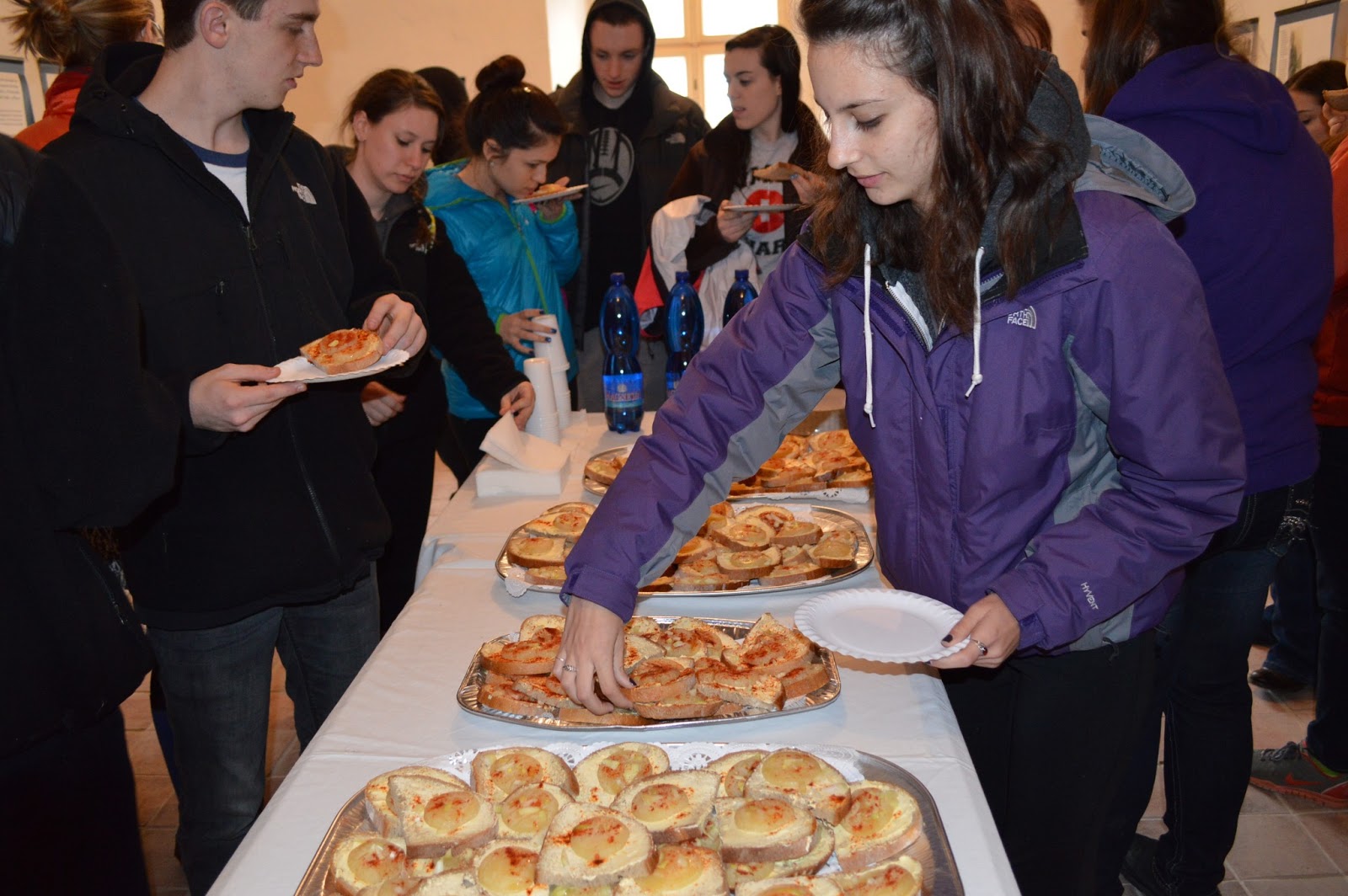
traditional Czech greeting: bread dipped
in salt and a little plum brandy, and several members of the Boy Scout troop
who we had met last year and would be spending the day with us.


Inside the building we were officially greeting by the
mayor, who stood before a large traditional Czech wedding cake decoration which
she thought we might like to see. Dr.
Brezina, who was 5 when the Wolfs went into hiding and never knew Otto Wolf,
but met the surviving Wolfs after the war and had been to the hideouts, told
his story, and then Mrs. Ohera, whose family had provided food and shelter for
the Wolfs and whose father was one of the 19 men rounded up and killed by the
Nazis in April 1945, told of her memories.

After we signed the official town records book for visitors,
we headed down the hill to the restaurant where the town hosted a lunch for us,
the Vavreckas and the Boy Scouts. As the
time for the memorial unveiling approached, we left the restaurant and as we
did so we noticed from every street, townspeople walking down the hill, up the
streets, converging on that area which was the town square and site of the
memorial. It was a wonderful and moving sight to see how
supportive of the memorial the people of the town were as we all met and stood
before the blanketed memorial. The
police had stationed a car at the end of the street and an officer redirected
any cars from the other end of the street – though there is not much traffic in
Trsice.


Petr Papousek opened the ceremonies with a history of the
memorial project, and introductions of the visiting dignitaries: the Governor of Olomouc, the Senator from the
area, the parliamentary representative, Mayor Leona and other mayors from
surrounding towns. Our guide Ilona
provided the translations for us.


There were several speeches from each of the officials. Petr then thanked and introduced the individual
who made this memorial possible, Dr. Joan Silber, who spoke and thanked the
people of the town for their bravery and resistance in the face of Nazi
oppression. She also thanked the lead
teacher of our group, Mrs. Colleen Tambuscio, for all of her efforts to bring
about this memorial dedication. Eva
Vavrecka was then introduced and she also thanked the people of Trsice for
helping her family and for their continued efforts to keep the memory of her uncle, through his diary, alive.


After Dr. Joan Silber and the Governor of the Olomouc
Regional Government unveiled the memorial, two of the Boy Scouts, standing
before the memorial, read excerpts from
Otto’s diary.


The inscription on the memorial in Czech and English reads:
“When the
Nazi Germans imprisoned and killed large numbers of the Jewish population of
Europe, citizens of Trsice hid members of a Jewish family – Berthold, Ruzena,
Felicitas, and Otto Wolf – from 1942 until 1945 at great risk to their own
lives.
Initially this heroic act was done
by Jaroslav Zdaril of hn (house number) 172, Ludmila Chodilova nee Ticha of hn
290 and Oldrich and Marie Oher from Zakrov of hn 1. As time went on many other citizens of Trsice
learned of the hiding place and kept the secret.
This monument honors them and the
memory of Jewish residents of Trsice, Anna, Blanka, and Eliska Kornbluh who
were found and sent to the Terezin camp on 26.6.1942, and then on 20.8.1942 to
Riga, Lithuania where they were murdered.”
“The Jewish Community of Olomouc,
the town Trsice, the Olomouc Regional Government and the Organization for the
Support of Burned Villages with support from the U. S. Commission for the
Preservation of American’s Heritage Abroad made possible by Member Joan Ellyn
Silber and by Sherman J. Silber”


To conclude the ceremonies, Petr read a prayer in Hebrew,
and then there were lots of photos and interviews by the press and
representatives of the various groups.
After the ceremony, we said goodbye to the Vavreckas, Mayor
Leona and Mrs. Ohera and climbed on the bus to take us to the entry point into
the forest to visit the memorial we dedicated last year. Some of the Boy Scouts accompanied us into
the forest as Shalmi, our intrepid leader, helped maneuver us through the muddy
pathways. Upon reaching the memorial, we
discovered that the Boy Scouts had once again set up a clothesline on which
were hung pages from the Holocaust Study Tour book from the previous year, as
well as newspaper accounts of last year’s memorial dedication.


At the memorial sight, Shalmi asked those assembled, both
students and scouts: What made some
people leave before the deportations began?
Why did some people, when they received their ‘invitations’ (deportation
notices) report to the address noted?
Why did others like the Wolf family, upon receiving their notices choose
to go into hiding? What do you believe
you would have done? These questions
fostered a lively discussion at the end of which Shalmi said, “I didn’t ask you
these to get an answer; because there are no answers. This is something that people struggle with
--- where would I have been?”


After hiking out of the forest we headed for Oswiecim,
Poland, the town where Auschwitz is located.
Auschwitz was the Germanization of the Polish name, Oswiecim. We are staying tonight in the Centre for
Dialogue and Prayer which was established in 1992. It is a Catholic institution founded by the
Archbishop Franciszek Cardinal Macharski in cooperation with the bishops of
Europe, in agreement with the representatives of Jewish organizations. The aim of the centre which was built in the
neighborhood of Auschwitz, is to create a place for reflection, education,
sharing and prayer. We will be staying
here overnight so that we can get an early start visiting Auschwitz I and
Auschwitz-Birkenau. We were greeted
briefly by Sr. Mary O’Sullivan who led us to the dining hall where we ate and
met our local guide for Poland, Eva, with whom we have worked for many years.
We checked into our rooms and Shalmi then proceeded to give
us the foundational information about Auschwitz prior to our visit tomorrow.